Official State Symbol
Quaking Aspen
About Quaking Aspen
The quaking aspen (Populus tremuloides) was designated the state tree by the Utah State Legislature in 2014 (Utah Code). The quaking aspen replaced the Colorado blue spruce, which had held the honor of state tree since 1933. The quaking aspen, which is also known as trembling aspen, makes up about 10% of the forest cover in the State of Utah and can be found in all of Utah’s 29 counties. In comparison, the Colorado blue spruce makes up about 1% of the forest cover and is primarily found in the Wasatch and Uinta mountains.
The change was initiated by fourth-grade students at Monroe Elementary in Sevier County who didn’t think that the blue spruce represented the State of Utah as a whole. The students chose the aspen because a colony of trees develops a singular root system. They say that reminds them of Utah where we all work together to reach new heights. Senator Ralph Okerlund (R-Monroe) sponsored S.B. 41 because “the quaking aspen provides Utah an economical, agricultural and recreational benefit.” The strong root system of the quaking aspen also appealed to Senator Okerlund because of the state’s emphasis on family history and genealogy. S.B. 41 passed 26 to 0 in the Utah Senate on February 10, 2014 and was sent to the Utah House of Representatives for their consideration.
Representative Brad R. Wilson (R-Kaysville), floor sponsor of S.B. 41, believes the quaking aspen is an appropriate symbol for Utah. “The aspen stems grow from roots of older trees,” Wilson said. “This creates a very important metaphor that we could connect to Utah as these children of the parents grow and are very prolific.” It passed 54 to 19 in the House of Representatives on February 19, 2014.
Governor Gary R. Herbert signed the bill on March 26, 2014 at Monroe Elementary in front of the students who inspired the change. The governor signed the bill with 13 pens made from quaking aspen while sitting on a chair and at a desk made from the tree, as well. On May 13, 2014 the quaking aspen officially became the Utah state tree.
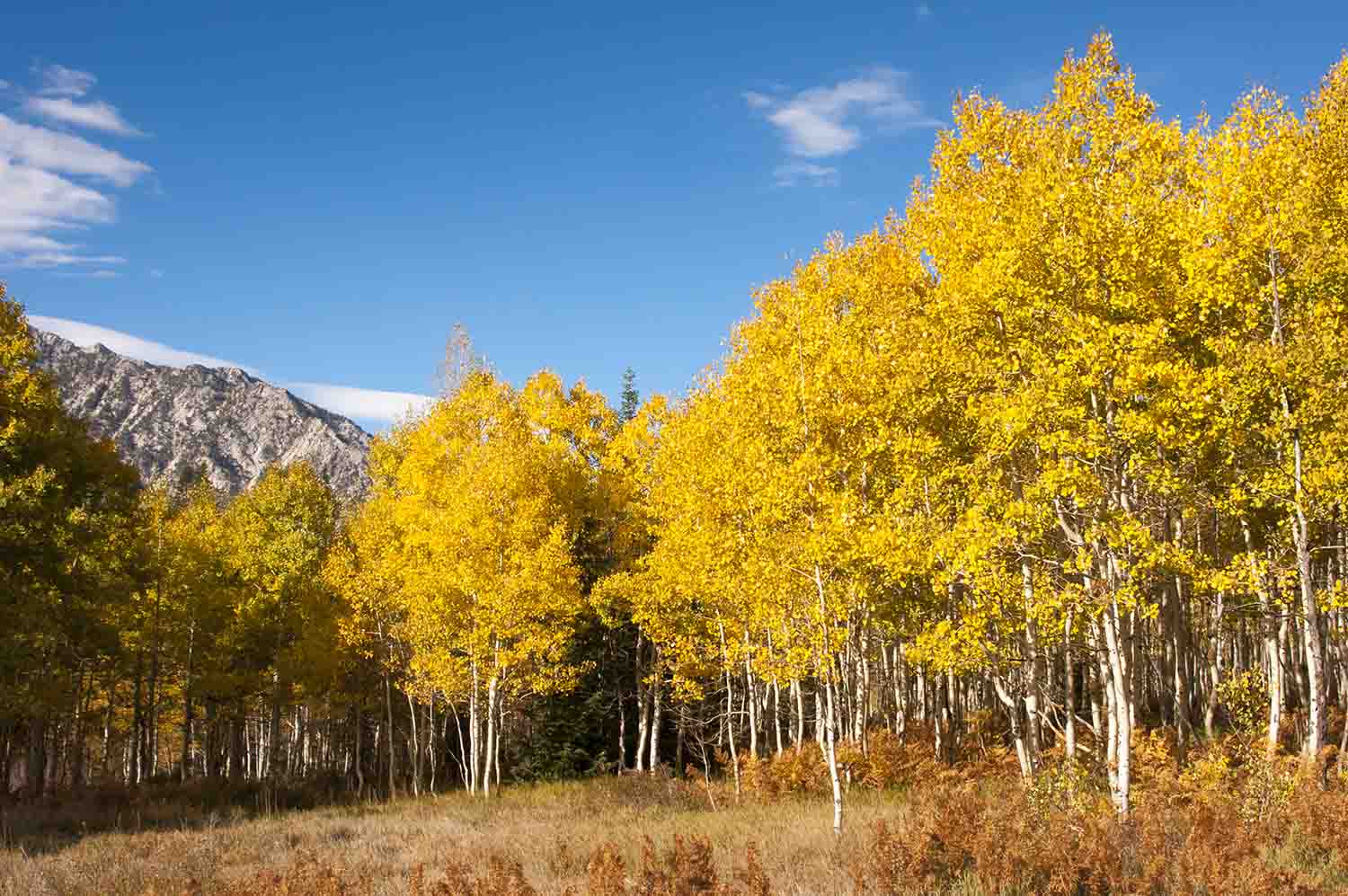
Populus tremuloides is known for its smooth, white bark and leaves that tremble in the slightest breeze. The trees, reaching heights of up to 82 feet, are characterized by their smooth, pale bark, which is marked with black scarring. Their glossy green leaves, dull on the underside, transform into shades of gold or yellow, and occasionally red, during the autumn season. It has the widest distribution of any tree species in North America. Native to the cooler regions of North America, this deciduous tree is one of several species commonly known as aspen. It is commonly called quaking aspen, trembling aspen, American aspen, mountain or golden aspen, trembling poplar, white poplar, and popple. While individual trees are relatively short-lived, this North American tree can live for thousands of years as a clonal colony through root suckers.
The Trembling Giant, or Pando (Latin for “I spread”), is a single clone of quaking aspen connected by one, massive underground root system. Pando’s root system of Pando is estimated to be 80,000 years old, making it one of oldest known living organisms on earth. It encompassed approximately 106 acres (43 ha) and is estimated to weigh in excess of 13 million pounds. Pando is located 1 mile southwest of Fish Lake on SR-25 in Fishlake National Forest. The Pando clone is struggling. Forest managers have noted a rapid dying of mature stems without recruitment of younger trees. Caused by human intervention, restoration will require protection, monitoring, and innovation.
The USDA Symbol for the quaking aspen is POTR5.